Senza categoria
A day at Venice’s Natural History Museum: an adventure for the whole family
24/11/2026
Venice is not just about palaces, art museums and canals. It is also a city full of surprises for younger visitors, with fascinating places where curiosity becomes the best way to learn and discover the world.
One of the attractions worth including in a family holiday is the Giancarlo Ligabue Natural History Museum, housed in the beautiful Fondaco dei Turchi, one of the historic buildings overlooking the Grand Canal.
An interesting experience for both children and adults, the museum takes visitors on a journey through millions of years of natural history, with dinosaurs, animals, fossils and lagoon environments to discover.
If you are staying on the Venice Lido, it makes a wonderful day trip during your holiday, perhaps combined with a stroll through the historic centre.
Even before entering, the museum impresses visitors with its setting: the Fondaco dei Turchi, an ancient Venetian-Byzantine palace directly overlooking the Grand Canal.
The building has a fascinating history. Over the centuries, it has served as an aristocratic residence and a centre of trade between Venice and the Mediterranean world. Today, it houses one of the city’s most important natural history collections.
The museum preserves a scientific heritage of more than two million specimens and offers a modern exhibition route designed to engage visitors of all ages.
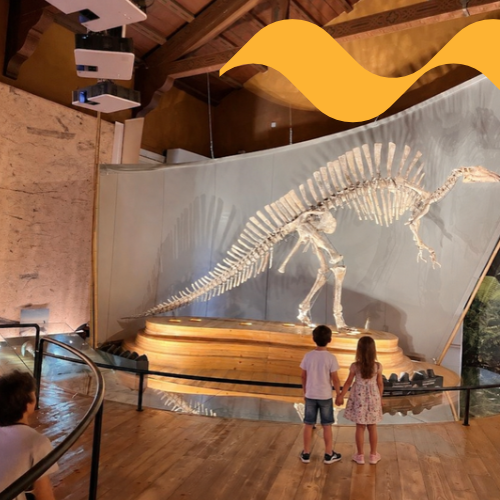
One of the most fascinating sections of the museum is dedicated to palaeontology and the history of life on our planet.
Children can discover fossils, reconstructions and evidence of animals that lived millions of years ago, learning how life on Earth has evolved over time.
Among the most spectacular exhibits are the finds from the great natural history expeditions, including those brought back from Giancarlo Ligabue’s expedition to Niger, which led to the discovery of important dinosaur remains.
It is a wonderful opportunity to introduce children to science through fascinating specimens, images and stories that spark curiosity and encourage questions.
One of the highlights of the visit is the Cetacean Gallery.
Here, visitors can admire the skeletons of large marine mammals, including a fin whale, and appreciate their extraordinary size and structure up close.
For children, it is a particularly exciting experience. Seeing the bones of such enormous animals helps them understand just how extraordinary the world beneath the sea really is.
The exhibition also offers an opportunity to talk about marine biodiversity, ecosystems and ocean conservation.
The museum also explores a fascinating environment close to Venice: the Tegnùe of the northern Adriatic.
These are unusual underwater rocky formations that provide valuable habitats for numerous marine species.
Through its Tegnùe aquarium, the museum introduces visitors to this ecosystem and its inhabitants, offering a glimpse into the biodiversity of the local sea.
It is an especially interesting section for introducing children to marine life and the importance of protecting natural environments.
The Natural History Museum is much more than a place to look at specimens and collections. It is a space that encourages visitors to ask questions, compare sizes, discover similarities and differences between species and understand the changes that have shaped our planet.
The modern exhibition layout offers different levels of information, making the visit engaging for both adults and children.
To make the experience even more enjoyable, an interactive audio guide called Audiopen is available. It is included in the admission ticket and accompanies visitors throughout the exhibition.
The museum is located in the Santa Croce district, inside the Fondaco dei Turchi, and is easily accessible by public transport.
From Hotel Rivamare on the Venice Lido, you can reach the historic centre by vaporetto. Lines 1 and 5.2 serve the Riva de Biasio stop, from where the museum is just a short walk away.
After your visit, you can make the most of the museum’s location to explore the nearby Santa Croce district, stroll along the Grand Canal or stop for a break at one of the cafés in the area.
The Giancarlo Ligabue Natural History Museum is located at Santa Croce 1730, inside the Fondaco dei Turchi.
Opening hours: