Senza categoria
A day at Venice’s Natural History Museum: an adventure for the whole family
24/11/2026
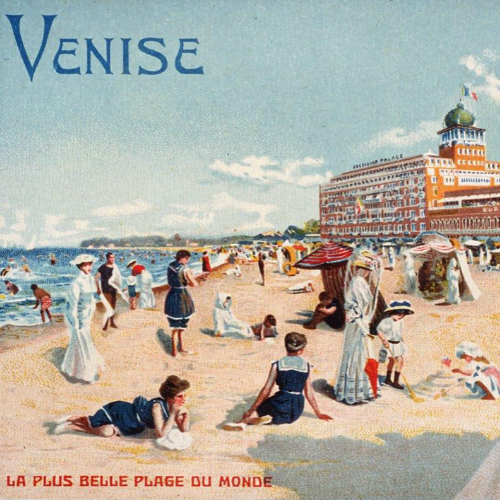
There was a time when spending the summer on the Venice Lido was synonymous with elegance, glamour and prestige. Between the late nineteenth century and the early decades of the twentieth, this narrow strip of land between the Adriatic Sea and the lagoon became one of Europe’s most sought-after seaside destinations.
These were the years of the Belle Époque, a period of great social and cultural change, when travelling and enjoying a summer holiday became an increasingly important part of the lifestyle of international high society.
The Lido embraced this new way of enjoying leisure perfectly. Grand hotels, state-of-the-art bathing establishments, elegant villas and long seaside promenades helped shape the image of a sophisticated island, where the charm of Venice met the pleasures of a seaside holiday.
Today, traces of this extraordinary era can still be found in the island’s architecture, landmarks and traditions.
The transformation of the Lido into a renowned tourist destination began in the second half of the nineteenth century.
In 1857, the first modern bathing establishment was inaugurated, while in 1872 the Società Civile Bagni Lido was founded, helping to organise and develop the island’s tourist facilities.
Connections with Venice were gradually improved, making the Lido increasingly accessible to visitors.
The possibility of easily reaching the beach from the historic centre was a remarkable innovation: in just a few minutes, visitors could leave behind the city of palaces and canals and find themselves by the sea.
Success soon followed. By the end of the nineteenth century, the Lido had become one of Italy’s and Europe’s most sought-after seaside resorts, attracting aristocrats and wealthy visitors from across the continent.
The early years of the twentieth century marked the golden age of seaside holidays on the Lido.
In 1900, the Grand Hotel Des Bains opened on Lungomare Marconi. At the time, it was an exceptionally modern establishment, equipped with innovative comforts such as lifts, telephones, private bathrooms and electric lighting.
In 1908, the Grand Hotel Excelsior opened, destined to become one of Europe’s most celebrated hotels. Its architecture, inspired by Moorish and Venetian styles, quickly made it an international symbol of luxury and hospitality.
Not far away, the Grande Albergo Ausonia Hungaria, with its extraordinary façade decorated with colourful majolica tiles, also embodied the refined taste of an era when architecture, art and hospitality came together.
These hotels were much more than places to stay. They were centres of social life, frequented by aristocrats, artists, writers and travellers from all over Europe.
During the Belle Époque, going to the seaside meant much more than simply swimming.
The beach was a social meeting place where people spent entire days enjoying conversations, walks, reading and moments of relaxation.
The characteristic wooden beach huts, neatly arranged along the shore, became one of the Lido’s most recognisable symbols.
For the time, bathing establishments offered remarkably modern facilities, including terraces, restaurants and entertainment areas. A seaside holiday thus became a complete experience, combining the pleasures of the sea with social life and leisure.
This bathing culture left a lasting mark on the island’s identity and remains one of its most fascinating features today.
The Lido captivated not only aristocrats and international travellers, but also the worlds of literature and the arts.
Among its most celebrated guests was the German writer Thomas Mann, who stayed at the Grand Hotel Des Bains in 1911.
The atmosphere of the hotel, the beach and the Venetian landscape inspired his famous novella Death in Venice, published in 1912.
The work helped spread the Lido’s reputation internationally, making it an important part of the literary imagination.
Even today, a walk along Lungomare Marconi offers glimpses of the atmosphere that inspired that remarkable period.
In the 1930s, the Lido acquired a new international identity.
In 1932, the terrace of the Hotel Excelsior hosted the first Venice International Film Festival, which would go on to become the world’s oldest film festival.
Since then, the island has become a landmark of international cinema, welcoming actors, directors and leading figures from the film industry every year.
The Film Festival has kept alive the special connection between the Lido, elegance and glamour that characterised the Belle Époque, renewing it through the language of cinema.
Today, the Venice Lido still preserves many reminders of this extraordinary era.
Liberty-style villas, historic hotels, beaches and characteristic beach huts continue to tell a story of elegance, culture and a love of the sea.
But the Lido is more than a reminder of the past. It is a lively island where traditional seaside life continues to meet the pleasures of a relaxing holiday, surrounded by beaches, nature and the close proximity of Venice’s historic centre.
Since 1938, Hotel Rivamare has been part of this tradition of hospitality. Located just a short walk from the beach and close to the Palazzo del Cinema, it welcomes guests into a warm and friendly atmosphere, keeping alive the pleasure of a seaside holiday in Venice.
Because the Lido is not simply a destination to visit, but a place to experience, where the elegance of the past continues to meet the pleasure of being on holiday.